

Multiple Views
Describing complex modern systems, whether for development purposes or post-release documentation, is no easy task. To fully understand all aspects of a large system, we need to look at it from different perspectives and use multiple techniques to describe it:
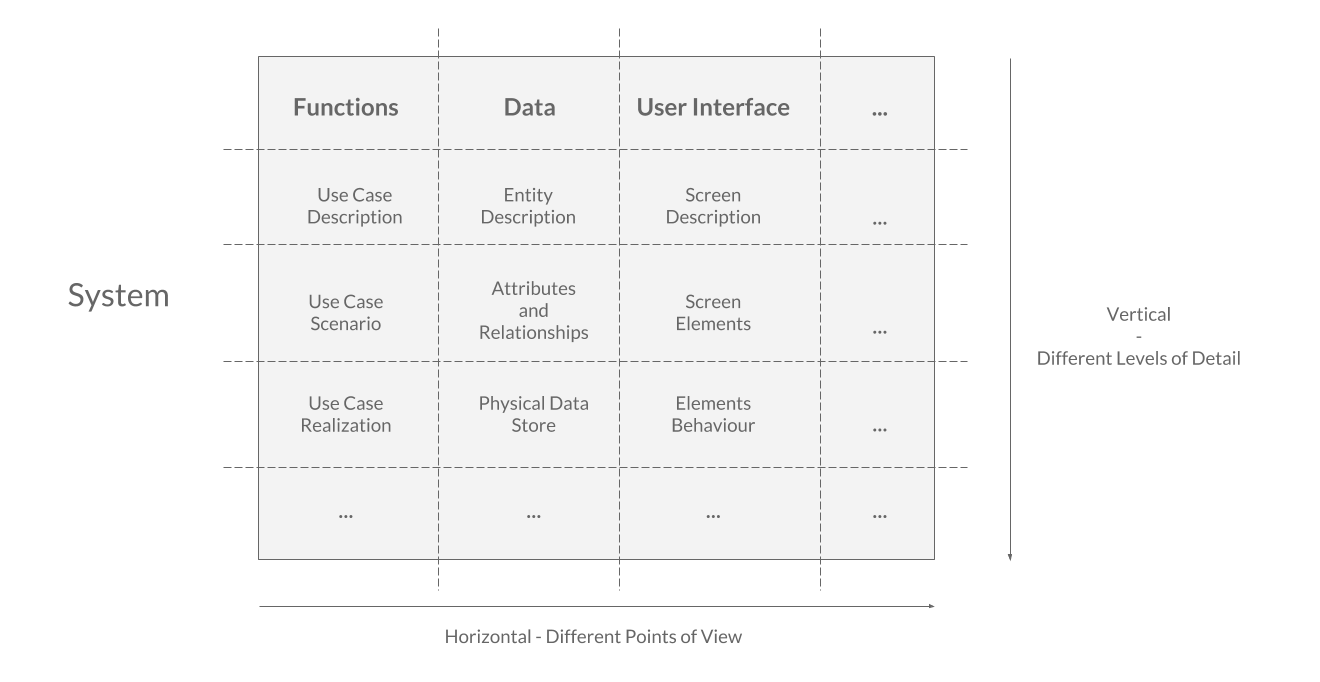
Each system can be viewed from two main perspectives: horizontal and vertical. The horizontal perspective describes different aspects of the system at a similar level of detail. The vertical perspective focuses on a single aspect but explores it across different levels of detail. While the number of horizontal aspects depends on the nature of the system and is relatively fixed, the team can choose the number of vertical levels based on their specific needs. The more detailed the analysis required, the more levels of detail are needed.
Horizontal View - Breadth
To describe a system, it is rarely enough to focus on just one aspect, such as the user interface. To get the full picture, the system must be understood from multiple perspectives: user interfaces, functions, data, security, etc. The following picture illustrates this principle: the diagram on the left shows a static view of how the system interacts with other systems, while the one on the right captures the dynamic view, including the sequence of communication.
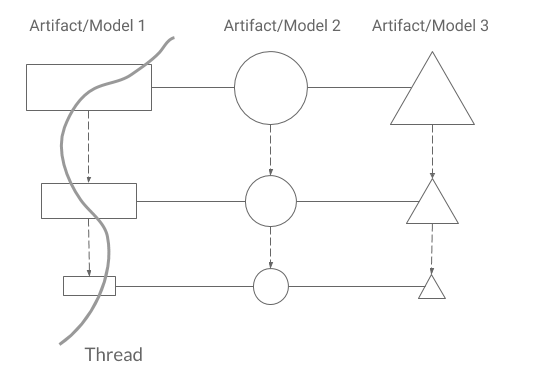
The goal is to replace multiple unrelated artifacts or models with a single, coherent view where all layers are interconnected. This makes it much easier to navigate between them and understand the problem as a whole:
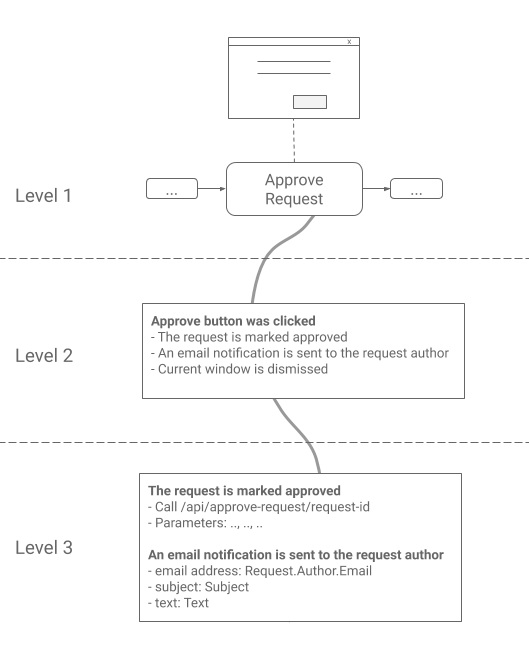
To achieve this, all views must be stored in a single repository, which makes navigation much smoother. In Part III, we will look at how specific tools can help with this approach.
Tips For Multiple Views
- Start with the process
When beginning to analyze a problem, it is always helpful to establish the context first. For business issues, this context is usually best expressed through a process. This tip is covered in more detail in this chapter. - Create tracing between different views
Another term for the Thread concept described above is tracing, which means establishing clear relationships between different views. There is an entire chapter dedicated to tracing.