
Deterrent Examples
In this chapter, we would like to present some real-world deterrent examples that should definitely not inspire you.
Example 1

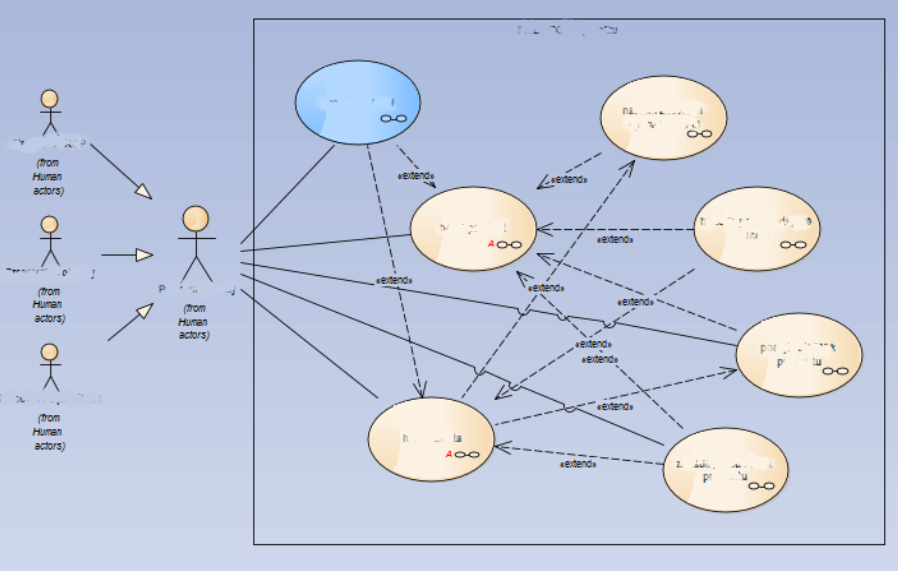
- Names should start with a capital letter
- Actors do not need to be stereotyped
- Use case names should follow the format
<verb> <direct object> - If the analyst decides to include a reference to the related business process (the grey "use case"), it should definitely not be modeled as a use case, let alone be placed within the system boundary and connected using the include relationship
- Use cases should be at the user-goal level without implementation details – the fact that messages are delivered via push notifications does not belong in a use case
- Deals with registration is an overcomplicated name – Sign up is much better
- Reads incoming messages is not a well-chosen name either. A use case should also reflect what the user wants from the system. The user wants to display messages, so the use case should be named Display messages
Example 2
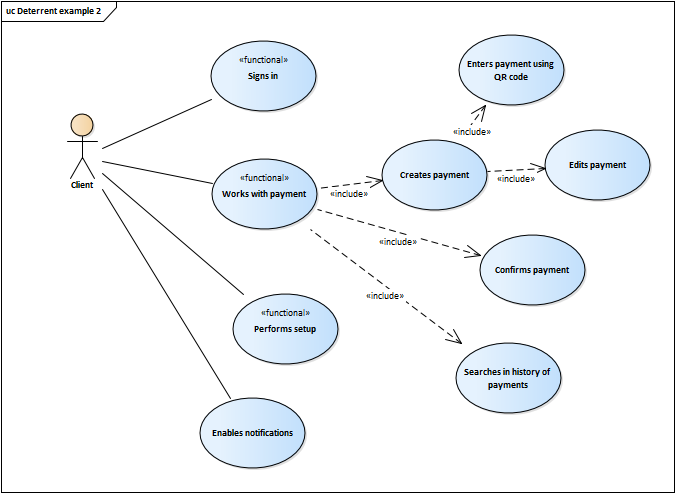
- Missing system boundary
- Names should not be in the third person
- Typical functional decomposition – many includes
- 'Works with payment' says nothing and serves only as a package for other functionalities. It is not a use case.
- Confirms payment is just a step or functionality; it should not be a use case
Example 3
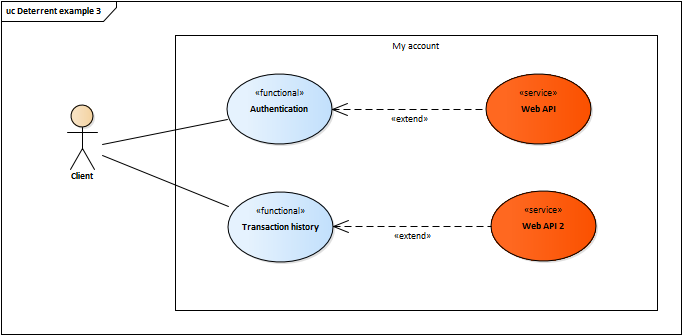
- It is not a use case diagram at all
- My account is not a system; it is a section
- The author just used use case notation to describe which services are called when two functions are triggered – don't do this
Example 4
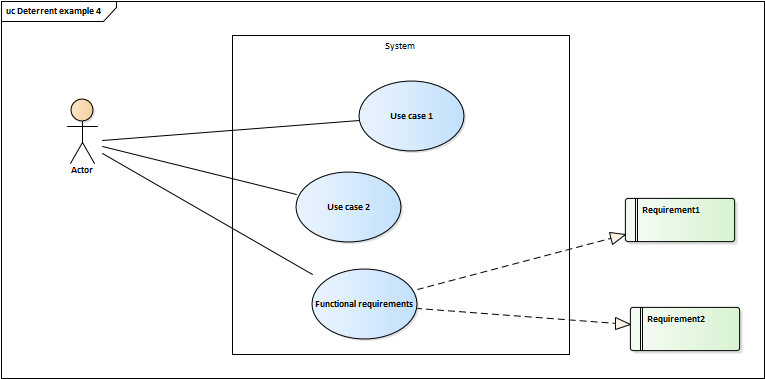
- Requirements should be connected directly to the use case that realizes them
- A use case called "Requirements" makes no sense
Example 5
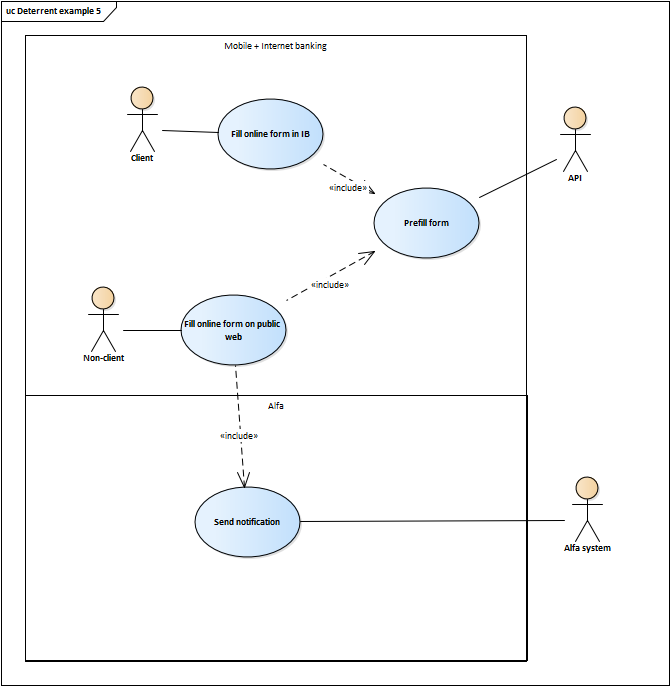
- A use case diagram represents use cases for just one system. Dividing the boundaries into two systems is incorrect.
- Actors should always be placed outside the system boundary
- If you decide to model a system as an actor (which we do not recommend), it should actually be a system. API is not a system.
Example 6
Use cases are tricky; even companies like IBM struggle to get them right:

Example 7
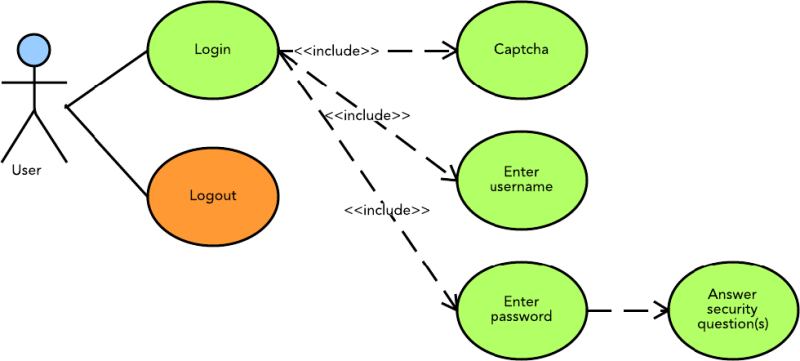
This example is from a tutorial presented by an online drawing tool used by thousands of professionals:
Example 8
No comment