

Business Rule
A business rule is a rule that defines or constrains some aspect of the business. For example, "Only customers older than 18 can buy products placed in the category Adults" constrains business because it stops adolescents from buying some products.
Business rules apply to people, processes, corporate behavior, and computing systems in an organization, and are put in place to help the organization achieve its goals
source: Wikipedia
Analysts come across many types of rules during their work, and they are not all the same. It is why we emphasize the business rules. For example, the statement "Only users with the role Manager shall be able to see the screen" is certainly a rule, but it is directly related to the specific information system, not to the business in general. On the other hand, business rules are not tied to any system, so they must be valid even if the whole company would have been operated using only pen and paper. For example, the rule "If the account balance reaches 0, customer cannot use the service anymore" must be true if the company uses complex information systems, but also if it stores all data in binders.
Business Rules Types
The business rules can be divided into the following groups:
Facts
Facts are statements which describe some aspect of the business, such as relationships between important business terms. The facts are always true and are usually documented in a data dictionary or in a domain model.
- Every product belongs to 1 or many product categories
Constraints
A constraint is a statement that restricts actions that might be performed within the business.
- Only customers older than 18 can buy products placed in the category Adults
Action Enablers
Action enablers trigger an action if specific conditions are true—"If the account balance reaches 0, the customer is notified by email".
Derivations
Derivations are very similar to action enablers. They are also written in the form of an if-then statement; yet, the then-clause does not trigger an action, but defines new knowledge instead.
- If the order is not paid within 30 calendar days after purchase, it is considered canceled
Computations
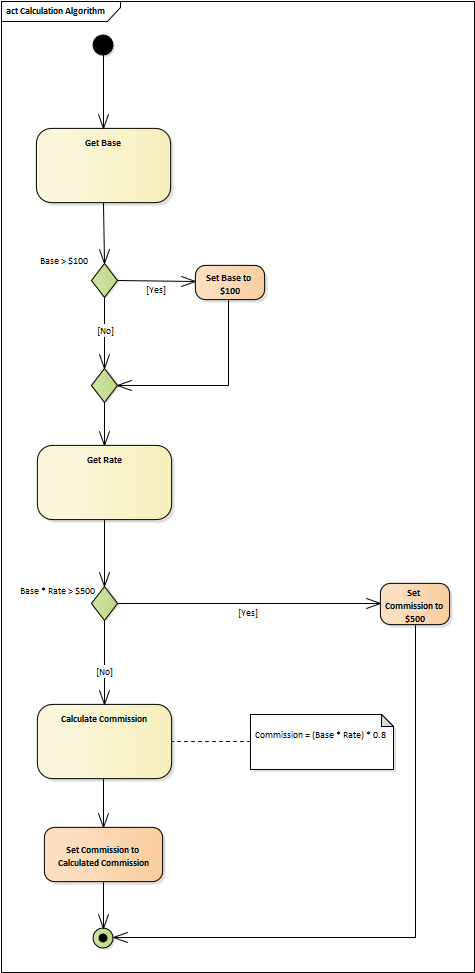
Each business includes rules specifying how to calculate business data. It could be a simple formula but also a complex algorithm. Simple rules could be easily captured in plain language, but computations or complex decisions are better described using decision tables or diagrams.
1/ Textual Rules
    Discounts:
    - If it is United Airlines and Paypal or Visa is used, customer gets 2% discount
    - If it is United Airlines and Mastercard is used, customer gets 1.9% discount
    - If it is American Airlines and Paypal is used and at least 3 tickets are selected, customer gets 1% discount
    - If it is American Airlines and Paypal is used and no luggage is selected, customer gets 1% discount
    - If it is American Airlines and the departure date is 24/12, all tickets customer gets a negative bonus -2% discount
2/ Decision Table
| United | American | Paypal | Visa | Mastercard | #Luggage | Dep. date | Bonus (%) |
|---|---|---|---|---|---|---|---|
| x | x | 2 | |||||
| x | x | 2 | |||||
| x | x | 1 | |||||
| x | x | 0 | 1 | ||||
| x | x | 24/12 | -2 |
3/ Activity Diagram
Terms
Some people consider business terms a specific type of business rule. That is fine, but in Effective Analysis, we store terms as separate artifacts, which is elaborated more in its own chapter.
Business Rules and Requirements
Even though business rules often look very similar to software requirements, making it sometimes not easy to distinguish between them, business rules are not requirements.
Business rules may generate software requirements if the goal is to implement the rule in a software system, but that is the only connection between them, as business rules are never part of any system. The business layer containing business rules must be separated from the software layer because otherwise, each system specification would have to duplicate the same rules over and over again, as business rules must be implemented in all systems that use them.
"If the account balance reaches 0, the account holder receives an email notification"
- It is a business rule because it is not associated with any particular system
- Corresponding requirement: "System shall send an email notification to the account holder if the account balance reaches 0"
Discount is calculated according to the following algorithm: ...
- It is a business rule because it is not associated with any particular system
- Corresponding requirement: "System shall calculate the discount (see the algorithm here) and shall display it to the customer before the order is submitted"
Order Management System: "Only employees with the BRN role are allowed to delete an order"
- This is a software requirement. If there were no Order Management System, this statement would not be valid.
Documenting Business Rules
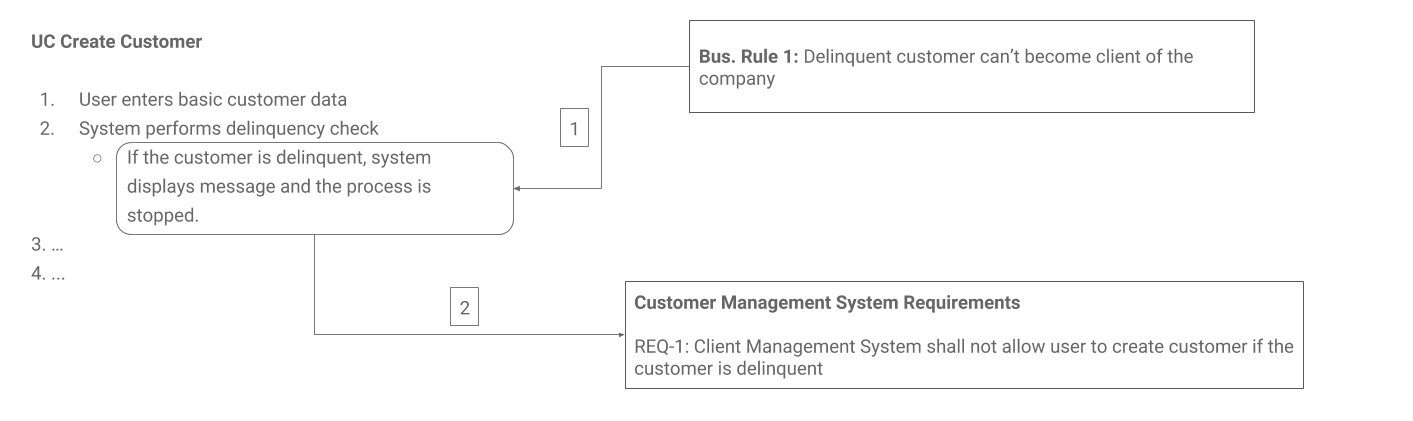
Business rules are a valuable enterprise asset that is shared among multiple departments and implemented in various systems. They are used on a daily basis, and, surprisingly, it is not a very common practice at companies to document business rules properly. As a company-wide asset, business rules should be stored in a central repository and only be referenced from where they are needed. Central management eliminates duplicate rules, enables storing all rules in one place, and referencing the rules is easy:
Instead, rules are usually stored in guidebooks, internal methodologies, and some are not documented at all, meaning they are only in people's heads. This requires analysts to find the right documents or people, which is frustrating and time-consuming